Solo Female Travel Safety: Practical Guide
A practical solo female travel safety guide: the habits experienced travellers actually use, how to research a destination properly, and what to do when something feels wrong.
Travelling alone as a woman is one of the most rewarding things you can do. It is also the thing everyone in your life will have an opinion about, usually an anxious one, usually from people who have never done it.
Here is the honest position this guide takes. Solo female travel safety is not about fear, and it is not about staying home. It is about building a set of small, unglamorous habits that make you a harder target and give you options when something feels off. Experienced solo travellers are not braver than you. They just have better systems.
This guide covers those systems. How to research a destination properly, what to do in your first hour in a new city, the habits that matter day to day, how to handle accommodation and transport, and what to do when your instincts tell you something is wrong. No fearmongering, no lectures about what you should be wearing. Just what actually works.
Solo Female Travel Safety Starts With Better Research
Most solo female travel safety advice starts at the airport. It should start weeks earlier, at the research stage, because destination choice shapes everything that follows.
Government advisories are a starting point for solo female travel safety, not the answer. Most countries publish travel advisories with tiered warnings. They are worth a glance, but they are blunt instruments. Those rankings do not always reflect the reality on the ground, and countries with their own significant safety challenges do not always rank themselves accordingly. Read the advisory, then keep going.
Weight recent traveller experiences more heavily. For real solo female travel safety insight, other women who have been there recently beat any official rating. Recent reports from other women who have actually been there are more useful than a government rating written for every category of traveller. Solo female travel communities, recent blog posts, and forum threads from the last year will tell you things no advisory ever will: which neighbourhood the harassment is concentrated in, which taxi apps locals actually use, whether the overnight train is fine.
Look for women-specific data. Some tools now rank destinations specifically on factors relevant to women, including harassment levels, theft risk, and local attitudes toward women. One index ranks over 200 countries on exactly these real-world factors rather than generic crime statistics. That specificity matters, because a country can be statistically safe overall and still be exhausting to move through as a woman alone.
Understand what actually makes a place easier. Reliable transport, walkable streets, accessible emergency services and good healthcare reduce daily stress enormously. When trains run on time and neighbourhoods are walkable, the mental load drops. This is why Japan, Iceland, Denmark and Singapore come up so often in solo female travel safety discussions. If Singapore is on your list, check whether you need a visa first: UK passport holders do not need one. It is less about crime rates than infrastructure that removes uncertainty.
Research the culture, not just the crime. Knowing local norms around dress, greetings, and public behaviour is a practical tool, not a compromise. It is worth checking what local women wear and adjusting where it helps you blend in. This is not about policing yourself. It is about reducing the number of times you stand out as a visibly disoriented outsider.
Solo Female Travel Safety Preparation Before You Go
A few things done at home make the whole trip easier.
Sort your connectivity before you land. Connectivity is a solo female travel safety essential. An eSIM means your data works the second the plane touches down, so you can call a ride share and find your accommodation immediately, rather than standing outside an airport at 10pm hunting for a SIM shop. This is one of the highest-value solo female travel safety upgrades of recent years, and it is cheap.
Save the local emergency numbers. They vary by country and you do not want to be searching for them in a crisis. Some apps map every international emergency number to your GPS location automatically, which is worth having.
Download offline maps of your destination. Never assume you will have signal. Your data may run out or the signal may drop exactly when you need it.
Share your itinerary with someone you trust. This is basic solo female travel safety practice. Not a vague "I'm going to Vietnam" but the actual details: where you are staying, when you are moving between cities, your flight numbers. Someone at home should be able to tell where you should be on any given day.
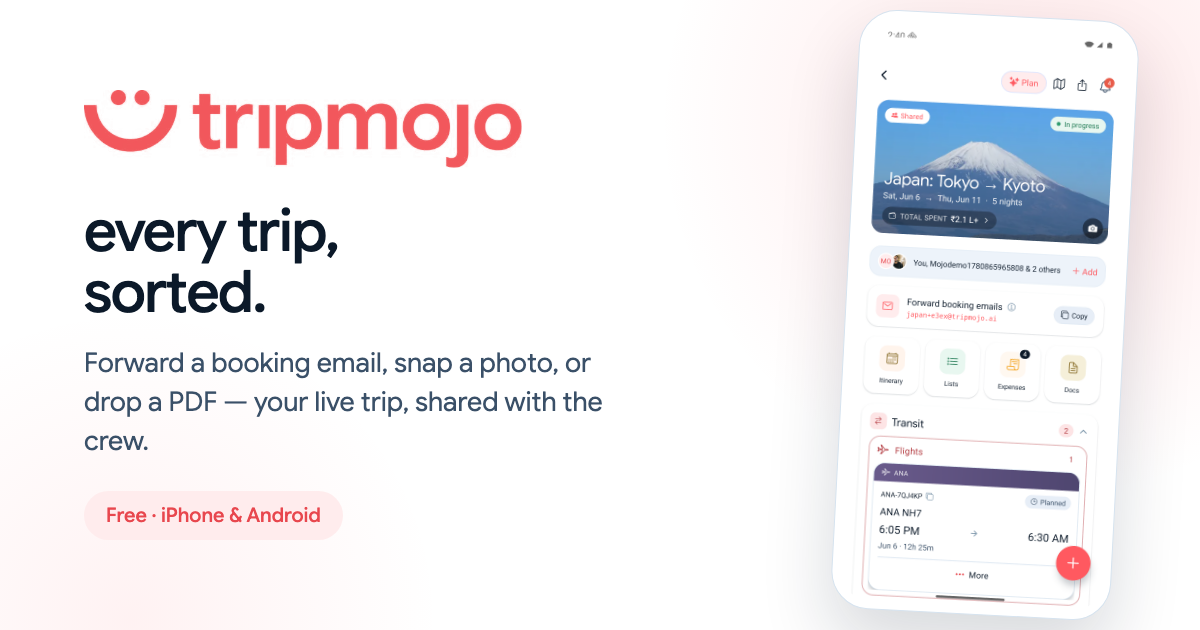
That last point gets much easier with a bit of organisation. Keeping your accommodation addresses, booking references and emergency contacts in one offline-accessible place means you can produce any of it instantly, for a taxi driver, a hotel check-in or a worried parent. Tripmojo keeps the whole trip in one itinerary and lets you share a live link with family, so they can see where you are without you checking in constantly.
Get proper travel insurance and read what it covers. Not all policies are equal. Experienced travellers learn this the hard way, often via an injury abroad that turns into months of complications and eventual surgery. Check the medical coverage limits, and check whether it covers the activities you actually plan to do.
Photograph your documents. Passport, visa, insurance policy, and licence, stored somewhere you can reach offline. If your bag goes, you still have everything.

Your First Hour: Solo Female Travel Safety on Arrival
The arrival window is when you are most vulnerable, because you are tired, disoriented, carrying everything you own, and visibly new. A few habits fix most of this.
Arrive in daylight where you can. This is the highest-value solo female travel safety decision you can make. This single choice eliminates a large share of arrival risk. Book flights and buses that land in the afternoon rather than the small hours. It costs a little more sometimes and it is almost always worth it.
Have your transport sorted before you land. Know which ride share app works locally, or arrange an airport pickup through your accommodation. Do not step out of an arrivals hall with no plan and start negotiating with whoever approaches you.
Walk the immediate area in daylight. Many experienced travellers treat this as a ritual. Drop your bags, then walk the few streets around your accommodation while it is still light. You learn the lay of the land, calibrate your sense of direction, and identify which way feels comfortable and which does not. You also stop looking lost on day two.
Look like you know where you are going. Looking lost attracts exactly the attention you do not want. If you need to check a map, step into a shop or cafe to do it rather than standing on a corner turning your phone around.
Daily Solo Female Travel Safety Habits That Actually Work
This is the core of practical solo female travel safety: small repeatable behaviours, not dramatic precautions.
Split your money and cards. Never keep everything in one place. Some cash in your day bag, some hidden in your luggage, a backup card somewhere separate. The classic trick of rolling emergency notes into a clean tampon casing still works precisely because nobody goes looking there.
Keep valuables boring. Leave flashy jewellery and expensive-looking gadgets at home unless you genuinely need them. The aim is not to look poor, it is to look unremarkable.
Trust your instincts, immediately and without apology. If solo female travel safety has one golden rule, this is it. If a situation feels wrong, leave. You do not owe anyone politeness, an explanation, or the benefit of the doubt. The social discomfort of walking away abruptly is nothing compared to the alternative, and experienced travellers consistently describe this as the single most important skill.
Have an exit line ready. Something simple like "my friend is waiting for me" ends most unwanted conversations. Some safety apps include a fake call feature for exactly this reason, giving you a plausible excuse to step away.
Be strategic about revealing that you are alone. You do not need to lie, but you also do not need to announce to a stranger on a bus that you are travelling by yourself and staying in room 304. Vagueness is free.
Watch your drink, always. Never let it out of your sight. If someone offers to buy you one, go to the bar with them and watch it being made. Once it is in your hand, do not set it down, not even for a moment. Moderate your drinking more than you might at home, because your judgement is your primary safety tool.
Keep your phone charged. A power bank is a safety device. A dead phone means no map, no ride share, no emergency call.

Accommodation and Solo Female Travel Safety
Where you sleep matters more than almost any other single decision.
Read reviews written by solo women specifically. They cover solo female travel safety details general ratings never mention. General ratings tell you about the breakfast. Reviews from other solo female travellers tell you whether the walk from the metro at night feels fine, whether the staff were respectful, whether the locks are solid.
Prioritise location over price. A cheaper place in an area you would not walk through at night is not cheaper once you factor in taxis every evening and the accumulated stress. Central and well-connected is worth paying for.
Check the basics on arrival. Does the door lock properly from the inside? Do the windows? If something is wrong, ask to change rooms. This is a completely normal request.
Consider women-only options. Many hostels offer women-only dorms and some accommodation is designed specifically for solo female travellers. If it makes you more comfortable, it is worth seeking out.
Do not post your room number or exact location in real time. Post the beautiful photo of the view after you have moved on, not while you are sitting in it.

Transport: Solo Female Travel Safety on the Move
For solo female travel safety on the road, use the ride share apps locals use, and check the licence plate and driver name before you get in. Share your ride status with someone if the app allows it.
Sit strategically on public transport. Near the driver, near other women, or in a carriage that is not empty. On overnight trains and buses, an upper berth or a seat away from the aisle can mean an undisturbed night.
Avoid unmarked taxis, and agree the fare or insist on the meter before you set off.
Keep your bag in front of you in crowds, and be alert around transport hubs, which are where opportunistic theft concentrates.
Handling Harassment
Let us be honest, because no solo female travel safety guide should pretend this does not happen. Street harassment is a reality in many places and it ranges from tedious to genuinely threatening.
Ignoring is usually the most effective first response. Engaging, even to tell someone off, often escalates it. No eye contact, no reaction, keep walking with purpose.
Move toward people. If someone is following you or the situation escalates, walk into a shop, a hotel lobby, a restaurant, or any populated space. Do not walk toward somewhere quieter, and do not walk directly back to your accommodation.
Be loud if you need to be. Drawing attention is a legitimate tool. Most people who harass rely on your reluctance to make a scene.
Ask other women for help. In almost every culture, approaching a group of women or a woman with children is a reliable way to get assistance.
Report what warrants reporting to local police or your embassy, but understand that responses vary hugely by country. Know where your embassy is before you need it.
The Mindset That Makes It Work
Here is the part that matters most, and it is the opposite of what the anxious people in your life will tell you.
Solo female travel safety is about preparation, not fear. The goal of every habit in this guide is to free you up to be bold. Travellers who have moved through dozens of countries alone consistently describe it the same way: safety is not about being afraid, it is about being prepared enough to be confident.
Solo female travel safety done well means you are never making decisions in a panic. It means when your instincts say something is wrong, you have already thought about what you would do. It means the boring logistics are handled so your attention is available for the things that actually matter, like the conversation you are having with a stranger who is about to become a friend.
Millions of women travel alone every year and have the time of their lives, and solo female travel safety is what makes that possible. The rare bad outcomes make headlines precisely because they are rare. Prepare properly, then go and enjoy it.
A Practical Solo Female Travel Safety Checklist
Run through this solo female travel safety list before every solo trip:
- Research the destination using recent traveller reports, not just government advisories.
- Sort connectivity with an eSIM or local plan arranged in advance.
- Download offline maps and save local emergency numbers.
- Book arrival in daylight and arrange transport from the airport in advance.
- Share your full itinerary with someone at home, including accommodation addresses.
- Check your insurance covers your actual planned activities and adequate medical costs.
- Photograph all documents and store them offline.
- Pack a power bank and a doorstop or portable lock if it helps you sleep better.
- Split your cash and cards across multiple places.
- Research local norms on dress and behaviour so you can blend where it helps.
The Bottom Line
Good solo female travel safety comes down to a handful of things. Choose your destination with real research. Handle the logistics in advance so you are never scrambling. Build small daily habits that make you unremarkable and hard to catch off guard. And above all, trust your instincts faster than you worry about being polite.
Do that, and travelling alone stops being the scary thing everyone warned you about and becomes what it actually is: one of the best decisions you will ever make.
Keep your accommodation details, bookings and emergency contacts in one organised itinerary you can access offline, and share a live link so family can see where you are. Try Tripmojo and travel with one less thing to worry about.
Written and fact-checked by Tripmojo’s editorial team. Drafted with AI assistance, then reviewed by Simran Raheja before publishing.
Related articles
 Road Trip Checklist: What to Pack (Free PDF)
Everything to pack for a road trip, organized by category, plus a free printable checklist PDF.
 Women's World Cup 2027 in Brazil - The Base-City Travel Guide
Plan the FIFA Women's World Cup 2027 in Brazil - all 8 host cities, ticket registration status, Rio vs Sao Paulo as bases, July weather and booking timing.
- Travel Insurance Explained: What You Actually Need
A practical travel insurance guide that explains what each type of coverage actually does, so you buy exactly the protection your trip needs and skip the padding you do not.
 First Time Flying Abroad from India: Airport & Emigration Guide
Planning your first international trip from India? Here is the complete step-by-step walkthrough covering airport counters, emigration, cash rules, and landing.
 Trip Cost Calculator Fuel: A Practical Road Trip Guide
Use a trip cost calculator fuel estimate to budget any road trip accurately, from petrol prices to tolls, group splits, and cross-border driving costs.
 How to Plan a Group Trip Abroad: A Practical Guide
Learn how to plan a group trip abroad with a clear step-by-step approach covering budgets, dates, accommodation, and keeping everyone on the same itinerary.