Best Places to Visit in Varanasi: A 2026 Travel Guide
Explore the 25 best places to visit in Varanasi in 2026 — temples, ghats, ashrams and sacred sites — with timings, the best time to go and a day plan.

Kashi Vishwanath Temple, the ghats between Assi and Panchganga, a sunrise boat ride, Sarnath's Buddhist ruins, Banaras Hindu University's museum, and Ramnagar Fort across the river cover the essentials. Add the old city's markets and a quieter half-day trip to Chunar Fort if you have longer to spare.
Varanasi rewards slow mornings and even slower evenings. This city on the Ganges has been a pilgrimage stop for thousands of years, and the list of places to visit in Varanasi runs from riverside cremation ghats to marble temples, a Buddhist stupa on its outskirts and a university campus with its own museum. I've spent enough dawns on a rowing boat here to know the difference between a rushed half-day and a trip that actually lets the city settle into you. This guide walks through the temples, ghats, ashrams and day-trip sites that are genuinely worth your time, with notes on when to turn up and how each one fits into a longer stay. For the practical side of things - dates, budgets and a day-by-day plan - our Varanasi destination guide covers that separately; here I'm sticking to what to actually see.
Top Temples & Places to Visit in Varanasi
Temple-hopping is the natural rhythm of a Varanasi morning, and most of the big shrines sit close enough together to cover on foot once you know the lanes. Kashi Vishwanath Temple, dedicated to Shiva, is the spiritual centre of the whole city and the reason most pilgrims come at all - security checks are routine and queues build fast, so an early start well before the main crowd is the easiest way in. A short ride away, Sankat Mochan Hanuman Temple has a different, more local feel: expect resident monkeys, a steady trickle of neighbourhood worshippers, and a Tuesday and Saturday crowd noticeably thicker than other days. Durga Temple, often called the Monkey Temple for the same reason, is a rust-red, multi-tiered structure a few minutes further on, worth seeing for its architecture even if you're not stopping to pray. Tulsi Manas Mandir sits within easy walking distance and is built in white marble with verses from the Ramcharitmanas carved directly into its walls - it's calmer than the others and makes a good last stop before lunch. None of these temples demand a full morning individually, but stitched together they make one.
| Temple | Best for | Ideal time |
|---|---|---|
| Kashi Vishwanath Temple | Core pilgrimage | Early morning |
| Sankat Mochan Hanuman Temple | Local atmosphere | Tuesday/Saturday evening |
| Durga Temple | Architecture | Mid-morning |
| Tulsi Manas Mandir | Calm reflection | Late morning |
Why are the ghats of Varanasi so famous?
The ghats are really the reason Varanasi's name comes up in every conversation about India's oldest cities. Stone steps run for several kilometres along the Ganges, and each one has its own character - some are used for laundry and bathing, some purely for cremation, and one or two exist mainly for watching the sunrise from a boat. Walking the full stretch on foot, from Assi Ghat in the south to Panchganga Ghat further north, is the single best way to understand the city's relationship with the river. Mornings are for bathing rituals and yoga; evenings belong to the aarti ceremonies. Between the two, the middle of the day is quiet enough for photography without a crowd in every frame.
| Ghat | Best for | Ideal time |
|---|---|---|
| Dashashwamedh Ghat | Evening Ganga Aarti | Dusk |
| Assi Ghat | Morning yoga and boats | Sunrise |
| Manikarnika Ghat | Observing rituals respectfully | Daytime, from a boat |
| Panchganga Ghat | Quiet river views | Late afternoon |
Dashashwamedh Ghat: the aarti everyone comes for
This is the busiest ghat by far, mainly because of the evening Ganga Aarti - a coordinated fire ritual performed by a line of priests each dusk. Arrive early to get a seat on the steps rather than a boat, since boats fill up fast in season. It's loud, crowded and a little touristy, but it's also genuinely moving the first time you see it.
Manikarnika Ghat: a working cremation ground, not a sight
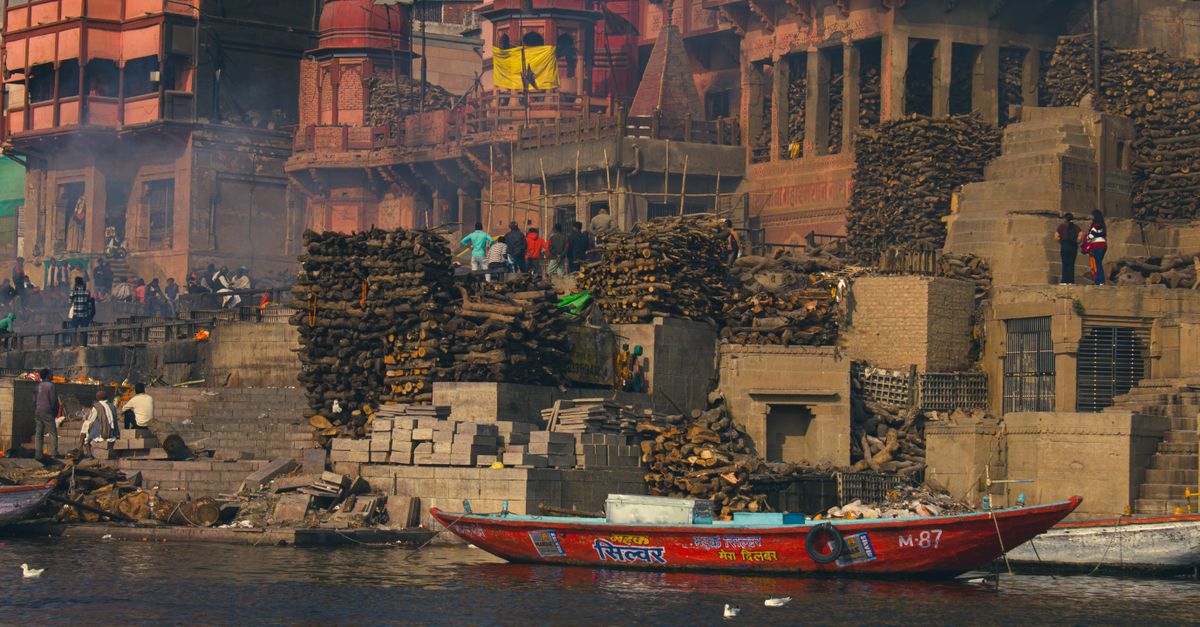
Manikarnika is one of the city's active cremation ghats, and it's respectful to treat it that way rather than as a photo stop. Guides sometimes offer a closer look in exchange for a donation - you don't need to take them up on it. Watching quietly from a slight distance, ideally from a boat on the water, is the more considerate way to witness it.
Warning: Avoid unofficial guides who approach you near Manikarnika Ghat asking for hospice donations - verify through your hotel or a registered guide first.
What is the best way to experience the Ganges at sunrise?
A dawn boat ride is the one thing almost every Varanasi itinerary agrees on, and it's worth the early alarm. Boats set out from Assi Ghat or Dashashwamedh Ghat while the sky is still grey, drifting north past Chet Singh Ghat and the tall, leaning buildings that back onto the water. The point isn't a single sight so much as the sequence: bathers wading in for their morning dip, priests setting up for the day's rituals, smoke already rising from the ghats used for cremation. Rowers rather than motorboats give a quieter ride and let you stop wherever the light is best. An hour on the water, timed to start just before sunrise, covers most of the interesting stretch without needing to arrange anything elaborate in advance. Evenings offer a second, louder version of the same ride timed around the Ganga Aarti, but the morning crossing is calmer and, in my experience, the better introduction to the river. Photographers should note the light changes fast in the twenty minutes after sunrise, so have your camera out before you leave the ghat rather than fumbling once you're on the water.
Tip: Agree a price and a route with the boatman before you get in - a one-hour sunrise loop is the standard ask.
Which ashrams and spiritual centres are worth a visit?
Beyond the big temples, Varanasi has a quieter network of ashrams and religious institutions that don't get nearly as much attention from first-time visitors. Kabir Chaura Math, associated with the poet-saint Kabir, sits in the old quarter of the same name and is worth a stop if you're interested in the city's syncretic religious history rather than just its Hindu temples. The Ramakrishna Mission's Home of Service runs a working ashram alongside its charitable hospital, and visitors are generally welcome to sit in on the calmer parts of the day - it's a good antidote if the ghats have started to feel overwhelming. Annapurna Math, close to Kashi Vishwanath, is dedicated to the goddess of food and nourishment and draws a steady stream of local devotees rather than tour groups. None of these places are set up as tourist attractions in the way the main ghats are, so go with a sense of quiet curiosity rather than an itinerary to tick off. Late morning, after the main rush at the bigger temples has eased, tends to be the easiest time to visit any of them without feeling like you're intruding.
Is Sarnath worth the day trip from Varanasi?
Sarnath sits a short drive from central Varanasi and marks the spot where the Buddha is traditionally said to have given his first sermon after enlightenment. It's a complete change of pace from the noise of the ghats - wide lawns, brick ruins and a calm that's rare anywhere else in the city. Most visitors combine the archaeological park with the museum and treat the whole trip as a half-day out, which is about right unless you're particularly drawn to Buddhist history. Go in the cooler part of the morning; the site has little shade and gets uncomfortable by midday in the warmer months.
Dhamek Stupa and the Ashoka Pillar remains
The Dhamek Stupa is the site's centrepiece, a tall cylindrical structure believed to mark the exact spot of that first sermon. Nearby, the broken remains of an Ashoka Pillar and the ruins of old monasteries are scattered across the grounds - there's enough left standing to get a real sense of scale.
Sarnath Archaeological Museum
The on-site museum holds sculpture recovered from the ruins, including pieces regarded as some of the finest Buddhist-era carving found in India. It's a small, manageable museum rather than an exhausting one, and it adds useful context to what you've just walked through outside.
What can you see at Banaras Hindu University?
Banaras Hindu University, generally shortened to BHU, is one of the largest campuses in the country and worth a couple of hours even if you have no academic reason to be there. The New Vishwanath Temple inside the campus is a modern take on the older Kashi Vishwanath design, built in white marble and open to visitors of all backgrounds without the same crowd pressure as the original. Bharat Kala Bhawan, the university's museum, holds a genuinely good collection of miniature paintings, sculpture and textiles, and it's usually calm enough to actually look properly rather than shuffle past. The campus itself, with its tree-lined avenues and unhurried student pace, is a useful contrast to the intensity of the old city a few kilometres away. Autos and cycle-rickshaws run from most central areas, and a morning visit works well since the temple and museum both keep sensible daytime hours rather than dawn-to-dusk ones like the ghats. If you only have time for one non-religious stop in Varanasi, this campus is a reasonable pick.
Where can you shop and eat like a local in Varanasi?
Varanasi's markets are as much a reason to visit as its temples. Vishwanath Gali, the lane leading up to the main temple, is lined with shops selling brass ritual items, prayer beads and the odd genuinely good silk scarf among the tourist stock. Thatheri Bazaar, named for its metalworkers, is worth a walk through even if you're not buying - the sound of hammering on brass and copper is distinctive to this one stretch of the old city. Chowk, the wider market area around Godowlia crossing, is where locals actually shop, and it's a good place to find Banarasi silk sarees and stoles at prices that reflect the fact you're buying alongside residents rather than only tourists. For food, the lanes near Kachori Gali are the place for a proper breakfast of kachori-sabzi and the city's own take on chaat, both eaten standing at a counter rather than seated. Evenings bring out sweet shops selling malaiyo, a saffron-scented milk foam that only appears in the cooler months.
Tip: Prices in Chowk and Vishwanath Gali are rarely fixed for tourists - a bit of polite bargaining, especially on silk, is normal and expected.
What other historic forts and monuments are near Varanasi?
Across the river from the main ghats, Ramnagar Fort is the old seat of the Kashi Naresh, the traditional royal family of Varanasi, and it's an easy add-on to a boat trip if you cross at the right point. The fort's museum holds a mixed collection of vintage cars, weapons, costumes and astronomical instruments, and while the building itself shows its age, that faded, lived-in quality is part of the appeal. Back on the main riverbank, Man Mandir Ghat is home to one of the observatories built by Maharaja Jai Singh II, similar in concept to the more famous Jantar Mantar in Jaipur - stone instruments for tracking the sun, moon and stars still stand on its upper terrace. It's a quick stop, best combined with a walk along the adjoining ghats rather than treated as a destination on its own. Both sites work well as an afternoon addition once the midday heat has softened, and neither draws the crowds that the main temples do, which makes them a good pressure release if the old city has started to feel overwhelming.
Are there quiet natural escapes near Varanasi?
If the density of the old city gets too much, there are a handful of quieter spots within reach. Rajghat, at the northern end of the ghat stretch, sees far fewer visitors and is a good place for a slow, uncrowded walk along the water. Further out, Chunar Fort sits above the Ganges on a low sandstone cliff and makes a solid half-day trip if you want a change of scenery and a decent view back over the river valley; it's quieter than anything in the city centre and rarely features on a first-time visitor's list. Vindhyachal, a small temple town a little further south, draws its own stream of pilgrims but at nowhere near the intensity of central Varanasi, and the drive out passes through open countryside that's a useful contrast to the old city's lanes. None of these are essential on a short trip, but if you've already covered the ghats, temples and Sarnath and have a spare half-day, they're a good way to see a different side of the region.
| Day trip | Distance feel | Best for |
|---|---|---|
| Sarnath | Short, half-day | Buddhist history |
| Ramnagar Fort | Across the river | Royal history |
| Chunar Fort | Half-day, further out | River views |
How do you get around Varanasi, and how much time should you set aside?
Varanasi's old city is largely a walking city - the lanes near the ghats are too narrow for much else - while auto-rickshaws and cycle-rickshaws cover the longer hops out to BHU, Sarnath or Ramnagar Fort. Most visitors find that three to four full days is enough to cover the temples, ghats, Sarnath and at least one further-out stop without rushing, though a tighter two-day version is possible if you stick strictly to the centre. If you want a day-by-day breakdown with timings and costs rather than just a list of sights, our full Varanasi guides collection and the how it works page walk through how Tripmojo puts an itinerary together, and the pricing page covers what a planned trip costs. The features page is worth a look too if you want to see how the planning tools handle things like boat bookings and aarti timings. None of that replaces good local judgement - starting early, carrying cash for small vendors, and dressing modestly at temples - but it does take the guesswork out of sequencing everything above into an actual trip.
The short version
This covers the essential places to visit in Varanasi, from the temple cluster and ghats to Sarnath and the quieter spots most visitors miss.
- Start with Kashi Vishwanath Temple and the ghat walk between Assi and Panchganga before the day heats up
- Book a sunrise boat ride from Assi or Dashashwamedh Ghat for the clearest view of the river's daily rhythm
- Set aside a half-day for Sarnath if Buddhist history interests you at all
- Cross the river to Ramnagar Fort or head further out to Chunar Fort once you've covered the old city
- Check our Varanasi guides for a day-by-day plan once you know which of these you want to prioritise
Frequently asked questions
How many days do you need to cover the main sights?
Three to four full days lets you take the temples, ghats, a sunrise boat ride and Sarnath at an unhurried pace. Two days works if you stick to the old city centre and skip the further-out stops.
What's the best time of year to visit?
The cooler months from October to March are the most comfortable for walking between ghats and temples. Summer gets very hot and the monsoon can flood some of the lower ghat steps, so shoulder months either side of the cool season are a good compromise.
Is Varanasi safe for solo travellers?
Generally yes, and it's a common stop for solo travellers of all ages. Usual city precautions apply - agree prices before rides or boats, keep valuables close in crowded lanes, and be firm but polite with touts near the main ghats.
How do you get around the old city itself?
On foot. The lanes near the main ghats are too narrow for most vehicles, so walking is standard, with cycle-rickshaws or autos useful for anything outside the immediate riverside area.
Do you need a guide for the ghats?
Not strictly, but a guide can help decode what's happening at a cremation ghat or during the aarti, which isn't always obvious to a first-time visitor. A boatman doubling as an informal guide is common and usually sufficient.
Is Sarnath included in a standard Varanasi visit or does it need extra time?
It needs its own half-day slot. Sarnath sits outside the main city and has a different pace entirely, so it's best treated as a separate trip rather than squeezed between ghat visits.
What should you wear when visiting temples?
Modest, covered clothing is expected at most temples - shoulders and knees covered is a safe rule. Some inner sanctums restrict certain items like leather, so it's worth checking locally before you go in.
Is the Ganga Aarti worth watching from a boat or the ghat steps?
Both work, but they give different experiences. Steps put you in the crowd with a close view of the priests; a boat gives distance and a wider view of the whole ceremony reflected on the water.
Can you visit Manikarnika Ghat as a tourist?
You can walk past and observe from a respectful distance, ideally from a boat, but it's an active cremation ground and not a sightseeing stop. Photography there is generally discouraged.
What's the easiest way to reach Varanasi?
Varanasi has its own airport with regular domestic connections, plus a major railway station on several long-distance lines, making both flying and train travel straightforward from most Indian cities.
Sources
- Cover photo by Arka Dutta on Unsplash
- Second photo by Adinath Gilande on Pexels
Written and fact-checked by Tripmojo’s editorial team. Drafted with AI assistance, then reviewed by Simran Raheja before publishing.
More guides
- Places to Visit in Puri: A Complete Group Trip Guide
Planning a group trip to Odisha? Discover the best places to visit in Puri, from Jagannath Temple to golden beaches, plus tips on where to base your group.
- Europe Itinerary Template: 10 Places Worth Adding
This Europe itinerary template helps you plan a group trip to Europe, covering top cities, the Alps and islands worth adding to your route this year.
- How to Plan a Group Trip to Europe: Best Places to Visit
Planning where to take a big group in Europe? Here's how to plan a group trip to Europe, plus the cities, islands and mountain towns that work best for groups.
- Best Places to Visit in Kolkata: A 2026 Travel Guide
Explore the 25 best places to visit in Kolkata in 2026 — landmarks, markets, temples and nightlife — with timings, the best time to go and a day plan.
- Best Places to Visit in Ahmedabad: A 2026 Travel Guide
Explore the 25 best places to visit in Ahmedabad in 2026 — landmarks, markets, temples and nightlife — with timings, the best time to go and a day plan.
- Places to Visit in Manali: 25 Best Picks (2026)
Discover the best places to visit in Manali, from Solang Valley and Old Manali to Hidimba Temple, Rohtang Pass, Jogini Falls and the quiet riverside cafés.